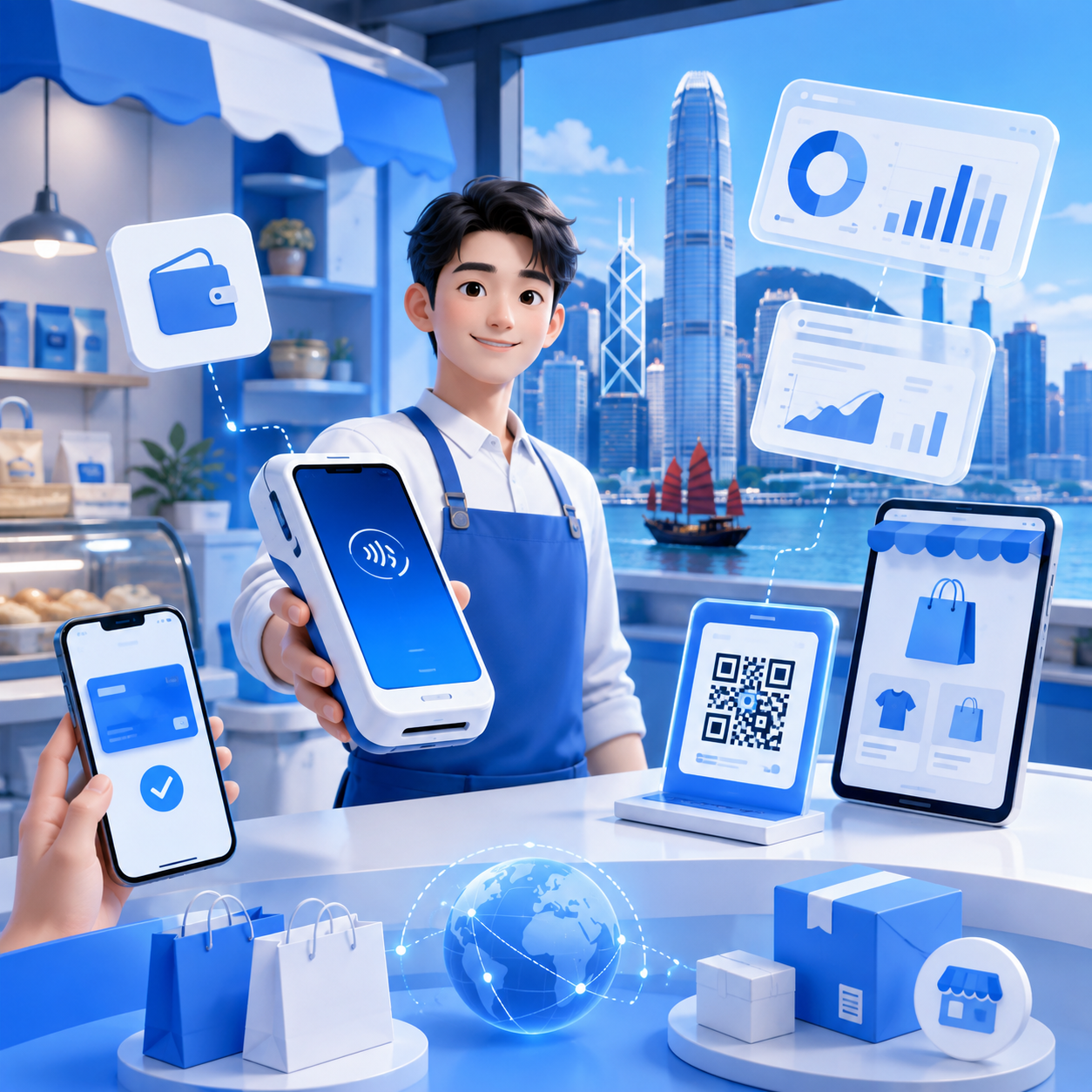
Restaurant Delivery and Takeaway Payment Experience Design: Shortening the Order-to-Payment Time
During peak lunch hours, customers queue up at the cashier, often not waiting for their food, but for payment. Even with online ordering, delivery, and self-pickup options available, just two extra steps in the checkout process, a few seconds' delay in payment, or staff needing to reconfirm an order can significantly lengthen the 'order-to-payment' flow and severely degrade the customer experience.

During peak lunch hours, customers queue up at the cashier, often not waiting for their food, but for payment. Even with online ordering, delivery, and self-pickup options available, just two extra steps in the checkout process, a few seconds' delay in payment, or staff needing to reconfirm an order can significantly lengthen the 'order-to-payment' flow and severely degrade the customer experience.
Payment experience design isn't just about 'supporting more payment methods'; it's about using process and interface design to break down, remove, or even eliminate waiting periods. The design priorities for delivery and self-pickup modes also differ.
Why does checkout speed immediately impact table turnover and ratings?
During peak restaurant hours, a slowdown in checkout triggers a chain reaction: longer queues, congested kitchen areas, and staff distracted by payment and change. This ultimately creates a bottleneck where 'orders are complete but customers can't leave.' Industry research also shows that if checkout takes over 2-3 minutes during peak times, customer perception and table turnover are significantly affected.
Psychological Time and Customer Experience
Another often underestimated factor is psychological time. Customers typically perceive 'waiting' as longer than it actually is, especially when the screen is unresponsive, payment results are unclear, or they have to ask staff again, 'Is it done?' — that's when the experience is at its worst.
Therefore, the goal of payment design is not fancy frills, but to eliminate the feeling of 'uncertainty' through predictable, simplified steps and instant feedback.
What are the differences to consider for delivery and self-pickup?
Delivery usually involves online payment, where customers typically complete their order and payment in just a few minutes. The real time consumption lies in food preparation and delivery. Key design priorities are reducing payment abandonment, minimizing failed payment retries, and clearly itemizing all costs.
Self-pickup is the opposite. Customers who are willing to come pick up their orders expect to 'arrive and collect.' If they still have to queue to pay, the entire value of self-pickup is significantly diminished. The design focus is to make payment a quick action upon arrival, or shift directly to prepayment.
Comparing Time Priorities for Both Models
The table below breaks down the time priorities for both models, from 'ordering to checkout,' to help with stopwatch measurement and improvement.
| Mode | Typical Process Nodes | Most Common Bottlenecks | Design Focus | Measurable Metrics (e.g.) |
|---|---|---|---|---|
| Delivery (Online Order) | Order → Checkout Page → Payment Authorization → Order Confirmation | Too many fields on checkout page, slow loading, payment failure requiring retry | One-page checkout, reduced input, clear costs, instant payment results | Checkout page completion rate, payment failure rate, average checkout seconds |
| Self-Pickup (Prepaid) | Order → Pay → Pick up at Store | Payment status not updated, staff can't find order | Payment success instantly updates order status, clear pickup code, short pickup process | Order delay after payment, pickup waiting seconds |
| Self-Pickup (Pay at Store) | Order → Queue at Store → Pay → Pick up | Single cashier handles payments one by one, staff needs to verify order and payment | Automated payment process, parallel channels | Queue time, seconds per transaction, peak throughput |
It's not about being faster, but about less 'waiting'
A single payment might only take 2 to 5 seconds to authorize, but customers still feel it's slow. This is usually not due to bank speed, but because process design stacks up 'waiting' moments.
Common Process Bottlenecks
Common bottlenecks typically fall into the following categories. When improving, start with the most severe problems:
- Slow network or terminal response
- Staff needing to verify each order individually
- Only one cashier, severe queues during peak hours
- Customers needing to find the right payment method before starting payment
- Unclear payment success screen leading to duplicate actions
Parallel Processing for Enhanced Efficiency
One of the core techniques in payment design is 'parallel processing.' For example, QR codes at tables, in-store self-payment, or using portable terminals to disperse payment points. Tasks that previously required queuing one by one can now be handled by multiple people simultaneously.
How to design online checkout pages to avoid customer loss?
For online prepayment in delivery or self-pickup, the biggest risk is 'abandoning halfway through.' Checkout page design principles should be clear and direct: fewer fields are better, shorter steps are better, and each step needs immediate feedback.
Checkout Page Design Checklist
Refer to the following practical checklist for optimization without major system changes:
- Required information: Only keep truly necessary data (e.g., phone for pickup notifications), others can be delayed or autofilled
- Payment options display: Place most commonly used e-wallets or contactless payments at the top to reduce selection time
- Error messages: Instantly highlight error fields and provide correction examples to prevent repeated attempts
- Loading and status: Clearly display progress after payment and prevent duplicate submissions
- Guest checkout: Avoid forced registration to prevent slowing down the process and increasing abandonment rates
Mobile wallets (like Apple Pay, Google Pay, local e-wallets, or other QR code payment methods) are fast not only due to quick authorization but also because 'no data entry is required.' If a checkout page still asks for a long address or repeated data entry, it negates the advantages of e-wallets.
Set Clear Goals to Enhance Experience
Some teams set a simple goal: from the moment a customer clicks 'Proceed to Payment' to seeing 'Order Confirmed,' try to keep it within 60 seconds. If achieved, the experience will significantly improve.
For self-pickup, how should payment be arranged for 'arrive and collect'?
Two situations should be avoided at self-pickup: first, customers arrive only to find they need to queue for payment; second, after payment, staff still spend time searching for orders, verifying names and amounts.
Best Practices for Prepayment and On-Site Payment
More mature approaches typically use two parallel tracks:
- One for 'prepayment,' where customers complete payment when ordering, and only identity verification or pickup code confirmation is needed upon arrival.
- The other for 'on-site payment without queuing,' using QR codes or portable terminals to disperse payment points, or even placing payment next to the pickup counter to shorten movement distance.
Payment Tool Selection and Cash Flow Management
If you operate a physical store, the choice of payment tools directly impacts implementation difficulty. Wonder offers Wonder Terminal for contactless tap, insert, and QR code payments; Wonder App for generating payment links or QR codes; and Wonder Dashboard for centralized transaction management and reconciliation. For the F&B industry, the most valuable aspect on-site is that customers can pay with their preferred method without increasing system integration burden due to multiple channels.
In terms of cash flow, if a store requires fast 'collection to settlement' speed, same-day settlement arrangements for the F&B industry (e.g., T+0 same-day settlement) help alleviate cash flow pressure and reduce reconciliation efforts at month-end.
What really takes time is the backend reconciliation after payment.
If front-end processes are sped up, but the backend still requires manual export of reports from multiple payment providers and individual reconciliation with POS orders, the time saved during peak hours will ultimately be made up by finance and store managers.
Backend Advantages of an Integrated Platform
The value of an integrated platform typically manifests in three areas: centralized transaction data, automated reconciliation, and rapid refunds/cancellations. Order changes, stockouts, and customer cancellations are particularly common in the F&B industry. If refund processes take days or require phone calls, front-line staff often choose 'not to deal with it,' leading to complaints and negative reviews.
Only when online delivery, self-pickup, and dine-in payments are integrated into a single backend can one truly understand which time slots, payment methods, or branches are slowing down checkout. This data can then be used for process optimization, rather than just for monthly reports.
Speed and Security: Not an Either/Or Choice
The most common problem in payment design is sacrificing security for speed, or adding too many interferences for security. The ideal balance is to handle verification through mechanisms familiar to the user, such as biometric authentication in mobile wallets, making customers feel both fast and secure.
Anomaly Handling and Backup Solutions
At the same time, a branching process for 'anomaly handling' needs to be designed. Unstable networks, failed QR code scans, or authorization timeouts can all occur. Customers must understand what to do next, and staff must have clear handling guidelines, such as retry prompts, using alternative payment channels, or providing backup networks.
The biggest taboo in payment experience is not an occasional failure, but when failure occurs and no one can clearly explain what happened, leading to repeated attempts and wasted time.
Want to see immediate improvement? Start with a small experiment during lunch hour.
Improving the payment experience doesn't require waiting six months to replace a system. Start by measuring with minimal cost, identify the biggest bottleneck, and then gradually optimize.
Small-Scale Experiments and A/B Testing
Start by choosing one store, one peak hour, and set a simple measurement method. For example, record the seconds required from 'customer starts payment' to 'staff confirms receipt' for every 20 transactions, and also record the number of failed retries. After two weeks, you'll discover the true bottleneck.
Then, conduct small-scale A/B tests. The following three directions usually show the most immediate results:
- Place the most frequently used payment methods in the most prominent position (online checkout page or on-site signage), observe if the average checkout time decreases.
- During peak hours, add 'self-payment entry points' (QR code or a second terminal), observe queue length and transactions processed per minute.
- Make payment success prompts clearer (screen, sound effects, pickup code), observe the number of times 'customers repeatedly ask if it's done.'
When processes are shortened, waiting points are reduced, and payment methods are comprehensive, delivery and self-pickup can become true accelerators, not just another queue requiring manual intervention. For the Hong Kong F&B industry, achieving 'payment completed in seconds' is not difficult; the challenge lies in perfecting every detail of the entire ordering-to-checkout process, making speed consistent and predictable.
You may also like