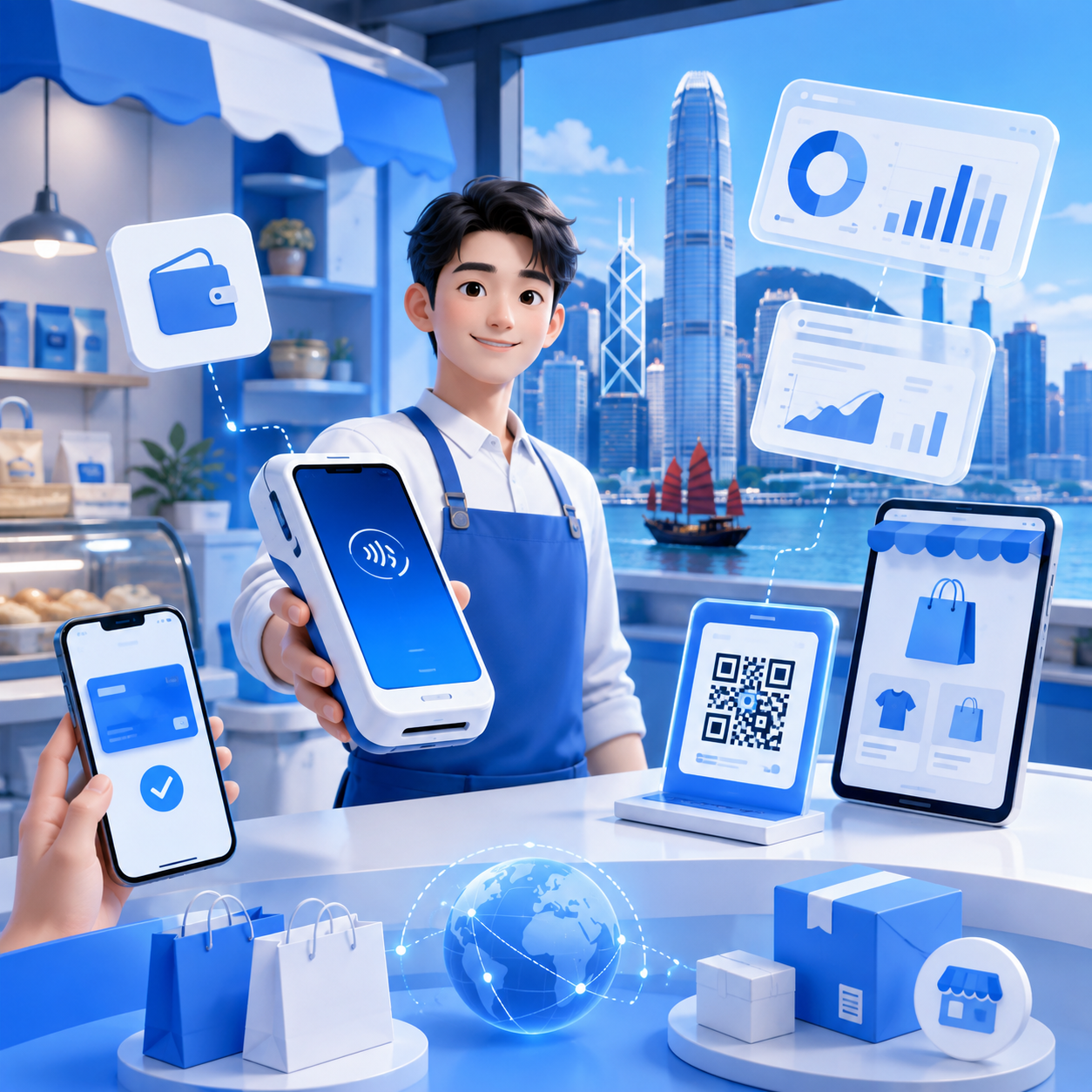
Hong Kong's One-Stop Merchant Payment Platform | Credit Cards + E-wallets + FPS - All in One Go (7-Minute Setup)
For Hong Kong merchants, payment collection has evolved far beyond simply 'having a card machine.' Customers now use credit cards, e-wallets, and FPS, and they might want to pay by scanning, tapping their card, or even paying online for in-store pickup. If merchants still handle applications, reconciliations, and reports separately, administrative tasks can quickly eat into valuable operating time.
For Hong Kong merchants, payment collection has evolved far beyond simply 'having a card machine.' Customers now use credit cards, e-wallets, and FPS, and they might want to pay by scanning, tapping their card, or even paying online for in-store pickup. If merchants still handle applications, reconciliations, and reports separately, administrative tasks can quickly eat into valuable operating time.
The value of a one-stop merchant payment platform lies in consolidating online and offline payments, deposit management, transaction records, and reconciliation. For restaurants, retailers, healthcare providers, educators, insurers, and even SMEs, this isn't just about adding another payment tool; it's about making the payment process clearer and faster.
Why are more and more merchants looking for an all-in-one payment solution?
Many merchants initially used different services for payments because they thought, 'as long as I can make a sale.' But as payment methods proliferate, problems gradually emerge. Credit cards have one backend, e-wallets another, and FPS requires checking yet another record. This often leads to missed orders, repetitive cross-checking, and staff spending excessive time compiling reports at month-end.
If you operate both a physical store and an online shop, the situation is usually even more complex. Customers pay on your website, pay the difference in-store, receive payment links via WhatsApp, and then scan a QR code on-site. Transaction sources become scattered, making it difficult for business owners to grasp daily revenue, refunds, unsettled amounts, and performance across different channels in real-time.
Common Pain Points
- • Long reconciliation times
- • Incomplete payment options
- • Separate data for physical and online stores
- • Non-transparent fees: Besides transaction fees, there might be monthly fees, terminal rental fees, or hidden costs.
- • Slow setup process: Repeated document submissions lead to missed peak seasons or new store opening opportunities.
- • Dispersed management: Store managers, finance teams, and business owners see inconsistent transaction data.
Can one platform handle credit card, e-wallet, and FPS payments all at once?
Yes, and that's precisely where a one-stop platform shines.
Take Wonder's merchant payment solution, for example. The platform covers up to 34 online and offline payment methods, supporting international card networks and commonly used local payment options, including Visa, Mastercard, JCB, UnionPay, Octopus, UnionPay App, WeChat Pay, Alipay, PayMe, and FPS. For merchants, the key isn't how many payment method names there are, but whether customers can instantly complete transactions using their preferred method at the counter or on the payment page.
For the Hong Kong market, local payment methods are especially crucial. Customers might not always carry cash, and not everyone wants to swipe a credit card. If a platform integrates both e-wallets and FPS, the flexibility of in-store payment collection significantly improves, which is particularly helpful for tourists, local daily spending, and efficiency-focused service industries.
Common Payment Methods & Applicable Scenarios
Common Payment Methods & Applicable Scenarios
| Payment Category | Common Methods | Applicable Scenarios |
|---|---|---|
| Credit & Debit Cards | Visa, Mastercard, JCB, UnionPay | In-store tap, insert, online payments |
| E-wallets | Alipay, WeChat Pay, PayMe, UnionPay App | Retail, F&B, Clinics, Education Fees |
| Local Instant Payments | FPS | Low-friction payments, service fees, fast transfers |
| Common Local Payments | Octopus | High-traffic stores, convenience-driven spending |
| Mobile Wallets | Apple Pay, Google Pay, etc. | Tap-to-pay, shortened counter time |
By integrating the above methods into one platform, merchants don't need to apply and log in to each channel separately, nor do they need to cross-reference multiple systems.
Which two tools are most practical?
For most Hong Kong merchants, daily operations essentially require just two tools: the Wonder App and Wonder Terminal.
Wonder App
The Wonder App is ideal for account opening, viewing transactions, managing deposits, and tracking payment performance. Merchants can complete applications via their phone and instantly view transaction records and payment status daily. For SME owners, the biggest difference is no longer having to wait until after work to know how much was collected today, which channels were most popular, and which transactions are still pending.
Wonder Terminal
The Wonder Terminal is a payment device designed for physical stores, supporting tap, insert, and scan-to-pay scenarios. It can connect via Wi-Fi or mobile networks. For merchants who need counter payments, delivery collections, mobile stalls, or in-car payments, it offers a more direct operational experience.
Key Advantages
- • Wonder App: Start account application in 7 minutes, centralize transaction, payment, and basic financial data management.
- • Wonder Terminal: One device handles credit card, e-wallet, and QR code payments.
- • Reconciliation: Centralized transaction data reduces manual sorting time.
- • Fees: Clearly stated transaction fees, as low as 0.8%, no contracts, no monthly fees, no terminal rental fees.
- • Instant transaction viewing
- • Supports simultaneous online and offline payment collection
Can setup really be completed quickly?
For merchants with complete documentation and clear company information, the setup speed can be very fast. Wonder utilizes a digital account opening process, allowing merchants to submit company information and required documents directly through the app. The application process averages just 7 minutes to complete, eliminating the inconvenience of traditional back-and-forth emails, paper signatures, and multiple reviews.
Approval Process and Security
Of course, actual approval times will still vary depending on the industry, company structure, beneficiary information, and document completeness. If the business is in a regulated industry, or has a more complex equity structure, the platform may require additional verification. This arrangement is actually beneficial for merchants, as it indicates the payment platform itself has robust risk control and compliance procedures, offering greater assurance for future fund security and account stability.
A fast process doesn't mean a careless process.
What are the practical differences for different industries?
F&B Industry
For the F&B industry, speed of payment and table turnover efficiency are usually paramount. Customers can freely choose to tap their card, scan, or use an e-wallet, and staff don't need to change their operations based on the payment method. If connected to an existing POS, front-end and payment data will be easier to synchronize. Some F&B scenarios even support T+0 instant settlement, which is particularly helpful for cash-flow sensitive merchants.
Retail Industry
The retail industry, on the other hand, emphasizes checkout efficiency during peak hours and the ability to integrate data from physical and online stores. When promotions, member discounts, on-the-spot refunds, and different payment channels occur simultaneously, a centralized backend makes management much clearer.
Healthcare, Education, and Insurance
For service industries like healthcare, education, and insurance, common scenarios involve numerous billing items and irregular payment timings. Some payments are collected on-site, some involve sending payment links, and some are paid by family members. If a platform can handle payment links, counter payments, and local transfer methods simultaneously, both front-line and finance departments will have a much easier time.
Taxis, Mobile Services, and Field Teams
For taxis, mobile services, and field teams, the focus is on device flexibility and the ability to complete transactions on the spot. Being able to collect payments in various locations, rather than being confined to a fixed counter, gives merchants more flexibility in accepting orders.
Beyond payments, data and reconciliation are actually more crucial.
Many merchants initially only look at transaction fees when choosing a payment platform; however, the long-term impact on operations often comes down to backend management capabilities. If daily transactions can be viewed instantly, automatically organized, and different payment methods integrated into a single report, the finance department can reduce repetitive tasks, and management can more easily determine which periods, which stores, and which payment methods perform better.
Long-term Benefits of Data Integration
This advantage typically isn't immediately obvious on day one, but as transaction volume increases, branches expand, or online payments are introduced, the difference will gradually widen. Simply reducing manual reconciliation, refund tracking, and settlement date verification can save significant internal costs.
What key points should you focus on when choosing a platform?
Merchants don't necessarily need to pursue the most feature-rich platform, but rather consider which features directly assist daily operations. If a platform can integrate payment collection, deposits, devices, reconciliation, and data management from the outset, expanding to new stores, new payment methods, or even adding online payments will be much smoother.
Practical Selection Criteria
When choosing, you can start by asking a few practical questions:
- • Can it connect all at once: Credit cards, e-wallets, Octopus, and FPS?
- • Is setup fast: Can the application be completed through a digital process?
- • Are fees transparent: Are there contract ties, monthly fees, or terminal rental fees?
- • Is reconciliation convenient: Does it support automatic organization of transaction data?
- • Does it support physical and online stores?
- • Is the device easy to use?
- • Are there instant transaction records?
The Real Value of a One-Stop Platform
If your business is preparing to open new stores, add more payment methods, or wants to consolidate existing fragmented payment tools, a clear, transparent, and fast-to-set-up one-stop merchant payment platform is often more practical than adding another standalone tool. Wonder, with its Wonder App and Wonder Terminal, allows merchants to handle everything from application and payment collection to daily management on a single platform, reducing system switching time and ensuring that payment collection truly supports business growth.
You may also like